
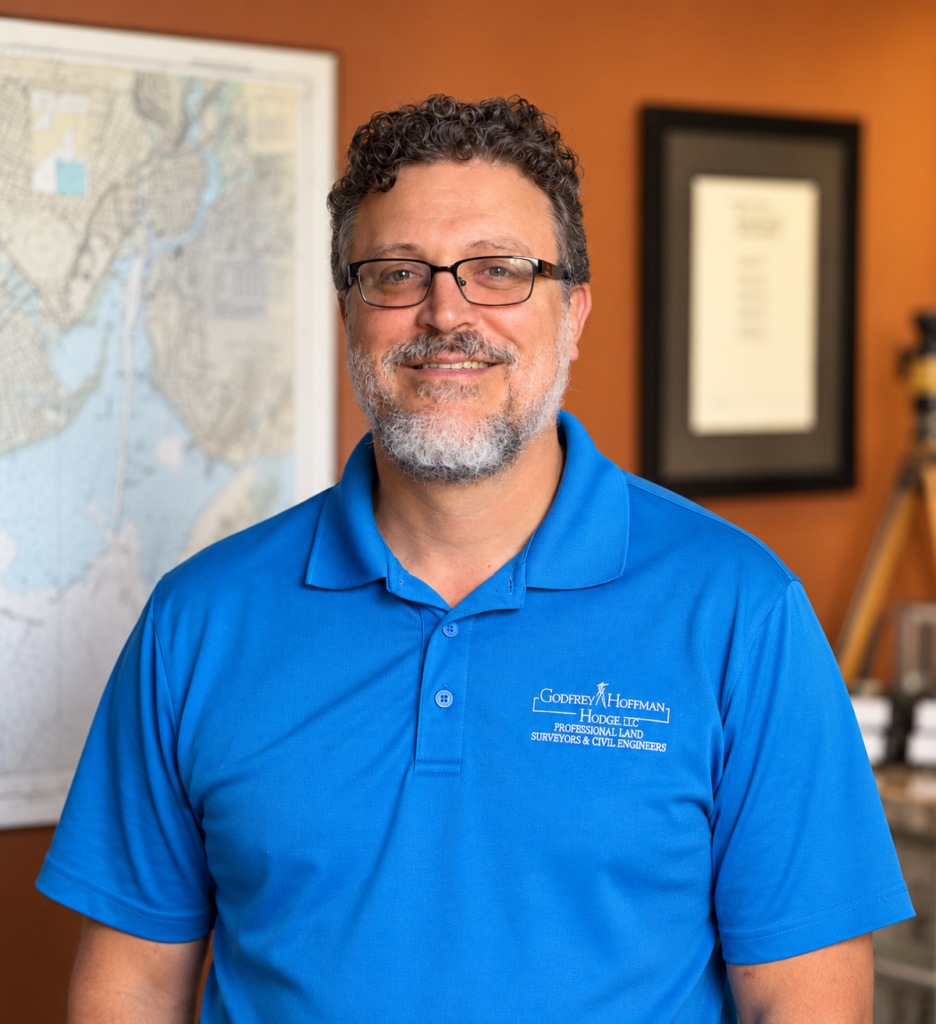
From initial site planning to final construction, successful projects require technical expertise, creative problem-solving, and a clear understanding of the land. As Director of Engineering at Godfrey Hoffman Hodge, Marcus Puttock brings all three to his work, drawing on his experience as both a licensed professional engineer and land surveyor.
For our latest Employee Spotlight, we caught up with Marcus to learn more about his role, the challenges of civil engineering, and what keeps him engaged after more than a decade with GHH.
Tell us a little about yourself and your time at GHH.
I’m Marcus Puttock, Director of Engineering at Godfrey Hoffman Hodge and a licensed professional engineer and land surveyor. I joined the firm in early 2015, so I’ve been part of the team for more than 11 years.
What does your role involve, and what do you enjoy most about it?
I primarily oversee civil engineering projects, from initial feasibility and site design through municipal approvals and construction. I enjoy solving practical problems and helping clients turn an idea into something that can actually be approved and built.
How do civil engineering and land surveying work together?
Surveying establishes property boundaries and documents existing site conditions. Civil engineering builds on that information to design proposed improvements.
Having a background in both disciplines helps me recognize potential issues early, understand the information we’re working with, and develop designs that respond to the actual conditions of a property.
What does a typical workday look like?
There really is no typical day. I might review plans and calculations, prepare proposals, meet with clients or municipal staff, visit project sites, answer questions from our engineering team, and attend an evening commission meeting. And that’s often across several different projects.
What’s the biggest challenge in your day-to-day work?
Balancing multiple active projects while responding to changing client needs, regulatory requirements, and deadlines. Every property and municipality presents different challenges, so even familiar project types require careful attention and sound judgment.
What’s changed the most during your career?
Technology has transformed nearly every aspect of our work. GPS, drones, CAD, GIS, digital modeling, and electronic submissions allow us to collect and evaluate much more information and develop plans more efficiently.
And what hasn’t changed?
The fundamentals. Accurate information, sound engineering judgment, attention to detail, and clear communication are just as important today as they’ve always been.
Technology helps us do the work, but it doesn’t replace professional experience or responsibility.
What keeps you motivated?
I enjoy the variety and the satisfaction of solving difficult problems. It’s rewarding to watch a project progress from an initial conversation through design and approvals, and ultimately into construction.